
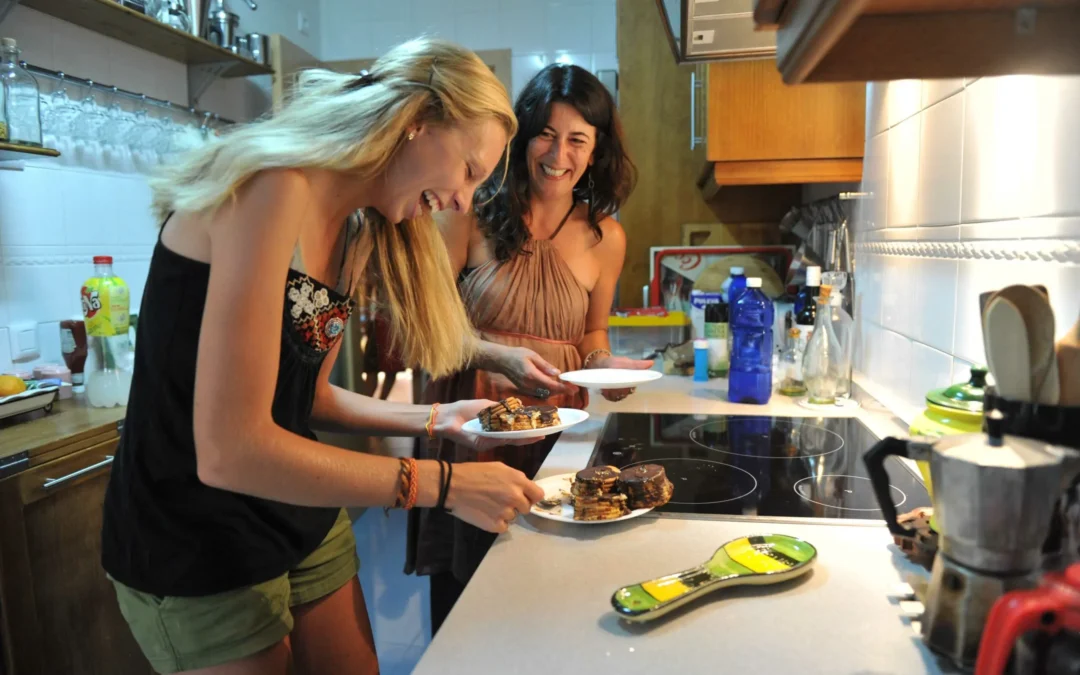
Quick answer: Choosing between a homestay or summer camp in Spain depends on your teen’s main goal. If the goal is to learn Spanish, a homestay is usually the best choice, because students use the language at home every day. A summer camp suits teens who want a sports-focused group experience. A travel tour is best for seeing many places but it offers the least language immersion.
Summer programs in Spain for teens come in three main formats. Each one shapes the summer in a very different way. This guide compares them on Spanish progress, independence, supervision and cost, so you can choose with confidence.
In this guide
- The three types of summer program in Spain
- Homestay or summer camp in Spain: side-by-side comparison
- Which option helps your teen learn Spanish fastest?
- Which option builds the most independence?
- What about safety and supervision?
- How do the costs compare?
- How to choose: 5 questions to ask
- Why Athena Spain chose the homestay model
- FAQ
The three types of summer program in Spain
1. Homestay programs
Students live with a local family in one town. They take Spanish classes during the day and share meals, conversations and daily life with their host family.
2. Summer camps (residence or campus)
Students live in a student residence or campus with other international teens. Days combine classes or sports with group activities, and meals are usually in a shared dining hall.
3. Travel tours
Students travel as a group through several cities or regions. They usually stay in hotels or group lodging and move every few days.
Homestay or summer camp in Spain: side-by-side comparison
| Homestay | Summer camp | Travel tour | |
|---|---|---|---|
| Spanish practice outside class | Every day, at home | Limited: often English with other students | Limited: mostly within the group |
| Cultural immersion | Very high: real family life | Medium | Wide but shallow |
| Independence | High: navigating a real town | Medium: structured campus life | Low to medium: guided group |
| Supervision style | Host family + program staff | On-site staff | Group leaders |
| Best for | Language progress and real connection | Sports and a group camp feel | Sightseeing across many places |
Which option helps your teen learn Spanish fastest?
A homestay usually leads to the fastest progress in Spanish.
The reason is simple: hours of real use. At a summer camp, students spend free time with other international students, and the shared language is often English. On a travel tour, the group moves together and conversations stay inside the group. In a homestay, breakfast, lunch, dinner and family outings all happen in Spanish.
Over four weeks, that adds up to many extra hours of listening and speaking. At Athena Spain, for example, host families do not speak English, so Spanish is the only language at home. For more on what to look for, read our guide on how to choose a Spanish immersion program in Spain.
Which option builds the most independence?
A homestay also builds the most independence.
Students learn to walk to class, shop at the market and solve small problems on their own, with the safety net of a host family and program staff. Summer camps and travel tours are more structured, which some parents prefer.
What about safety and supervision?
All three formats can be safe when the program is well organized. The difference is in how supervision works:
- Homestay: the program selects the host families, and local staff support students throughout the stay.
- Summer camp: staff live on site and the schedule is tightly structured.
- Travel tour: group leaders travel with the students.
When comparing programs, ask how host families are selected, who your teen can call at night and what happens if there is a problem. Before any trip, also check the official US State Department page for Spain.
How do the costs compare?
Costs vary widely, so compare what is included, not only the headline price.
- Summer camps often price by the week and may charge extra for excursions, transfers or insurance.
- Travel tours include hotels and transport between cities, which adds to the cost per week.
- Homestay programs often bundle classes, host family, meals, excursions and on-site support into one price.
Always check: meals, excursions, transfers, insurance, supervision and the flight.
How to choose: 5 questions to ask
- Is the main goal language, travel or a camp experience?
- How independent is your teen today?
- Do they want to see many places, or really get to know one?
- How will they practice Spanish outside class?
- What exactly is included in the price?
If language is the top priority, a homestay is hard to beat. You can also read what parents should consider before sending a high schooler abroad.
Why Athena Spain chose the homestay model
Athena Spain is a four-week homestay program in Conil de la Frontera, a whitewashed fishing town on the Atlantic coast of Cádiz. We chose this model because it gives students the most Spanish and the deepest connection to Spain.
- Host families known for nearly three decades: every family is personally selected by the program director.
- A careful match: each student has a phone call with the program director before placement.
- A backup plan: in the rare case a placement doesn’t work out, a new family is arranged quickly.
- 24/7 on-site staff for the full four weeks.
- Escorted group flight from New York JFK, so no one travels to Spain alone.
- The best of the other formats too: surfing, kayaking and beach volleyball in Conil, plus weekend excursions to Gibraltar, Córdoba, Sevilla, Cádiz and Madrid.
| Detail | Athena Spain 2027 |
|---|---|
| Format | Homestay + Spanish classes + activities + excursions |
| Base | Conil de la Frontera, Cádiz, Andalusia |
| Dates | June 26 – July 23, 2027 |
| Who | High school students in grades 9–12 |
| Spanish level | At least two years of high school Spanish, or equivalent |
| Classes | Monday–Friday, 10:00–13:30 |
| Included | Homestay, three meals a day, classes, all excursions and activities, in-country transfers, 24/7 support |
| Price | $8,295 + airfare |
Families can book a free call with Marta Ramos, President of Athena, before deciding. Apply for Summer 2027 →
FAQ
Is a homestay better than a summer camp for learning Spanish?
For most teens, yes. A homestay means speaking Spanish at home every day, while summer camp students often speak English with other international students.
Do host families speak English?
At Athena Spain, no. Host families speak only Spanish, which is why students need at least two years of high school Spanish before joining.
Is a homestay safe for a high school student?
Yes, when the program selects its host families carefully and offers local support throughout the stay. At Athena Spain, families are personally selected by the program director and local staff are on site 24/7.
What if my teen does not get along with the host family?
At Athena Spain, every student is matched after a phone call with the program director. In the rare case a placement doesn’t work out, a new family is arranged quickly.
Are travel tours good for learning Spanish?
They are great for sightseeing, but if the goal is real Spanish, staying in one town with a host family makes the difference.
Recent Comments